Exploring the Time-Honored Tradition of Florida Cane Boils from Farm to Bottle
The Florida Cane Boil: Liquid Gold, Labor, and Legacy
In the backroads of North Central Florida, long after summer’s humidity softens and the air carries the first whisper of fall, a centuries-old tradition still simmers—slow, steady, and stubbornly alive. The cane boil.
It is, at its surface, a harvest ritual.
But beneath that, it is memory. Labor. Ingenuity. Community. And history—rich, complicated, and impossible to separate from the sweetness it produces.
While many assume cane syrup is a relic of the past, fading into nostalgia alongside smokehouses and hand-cranked mills, that assumption misses the truth entirely. Across Florida, Georgia, and up through the Carolinas, cane boils still happen every fall. Not loudly. Not commercially. But faithfully, in pole barns, fields, and family farms where tradition is carried more by hands than headlines.
The Drive Out
On this particular Saturday, my family piles into a couple of cars and we head past the city limits, trading pavement for dirt roads and subdivisions for stretches of pine and open land. Eventually, we turn into a long, pine-lined driveway where the air already smells faintly of smoke and sugar.
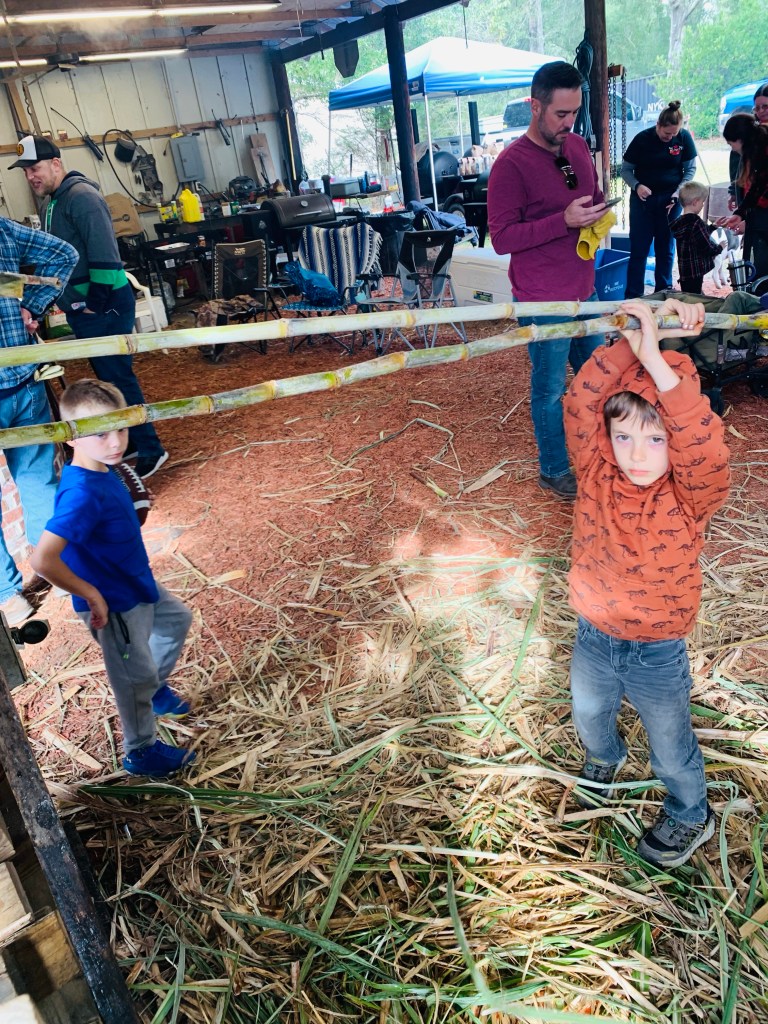
People are gathered near a pole barn.
Kids are running wild with water guns.
Someone is laughing loud enough to carry across the field.
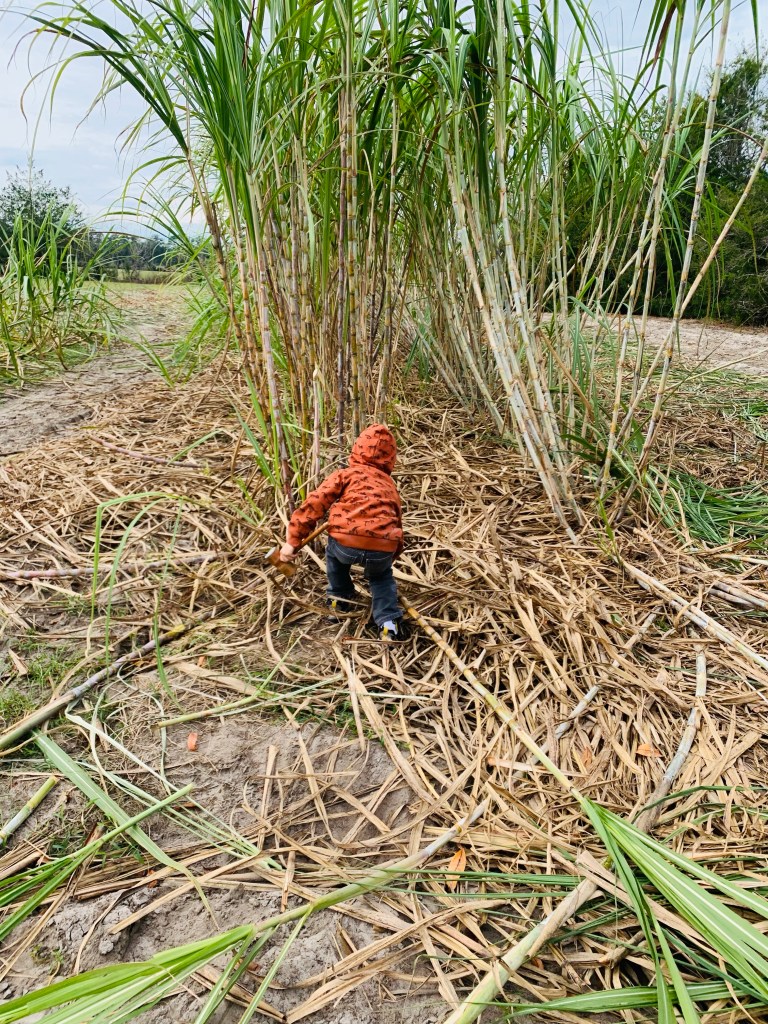
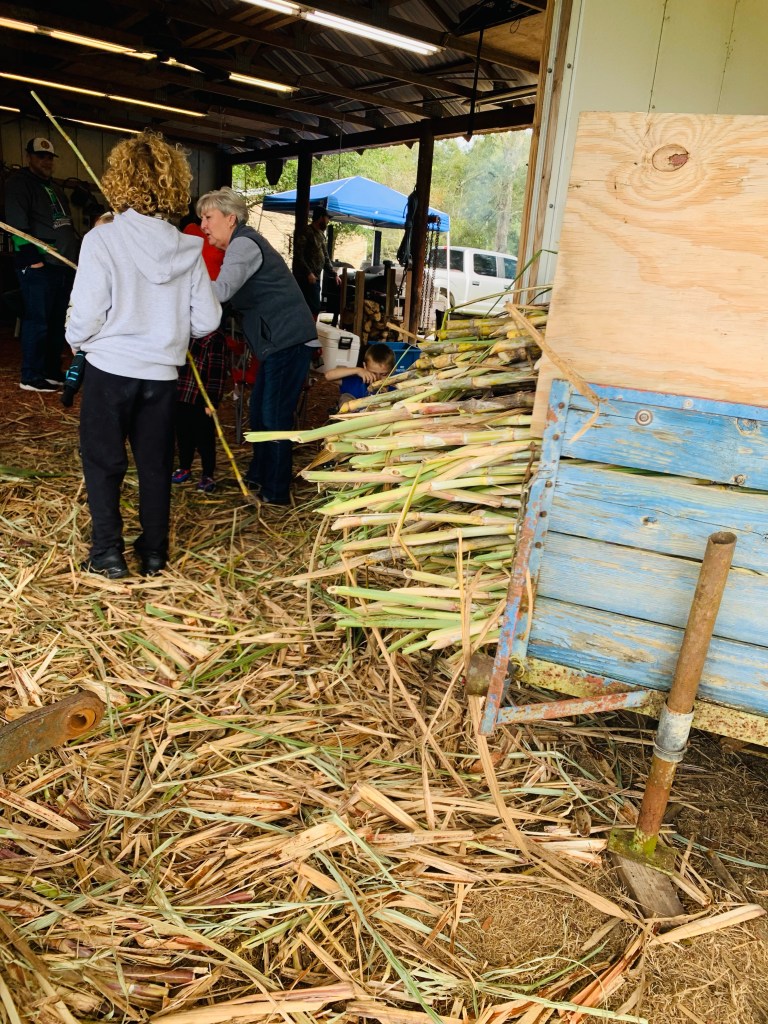
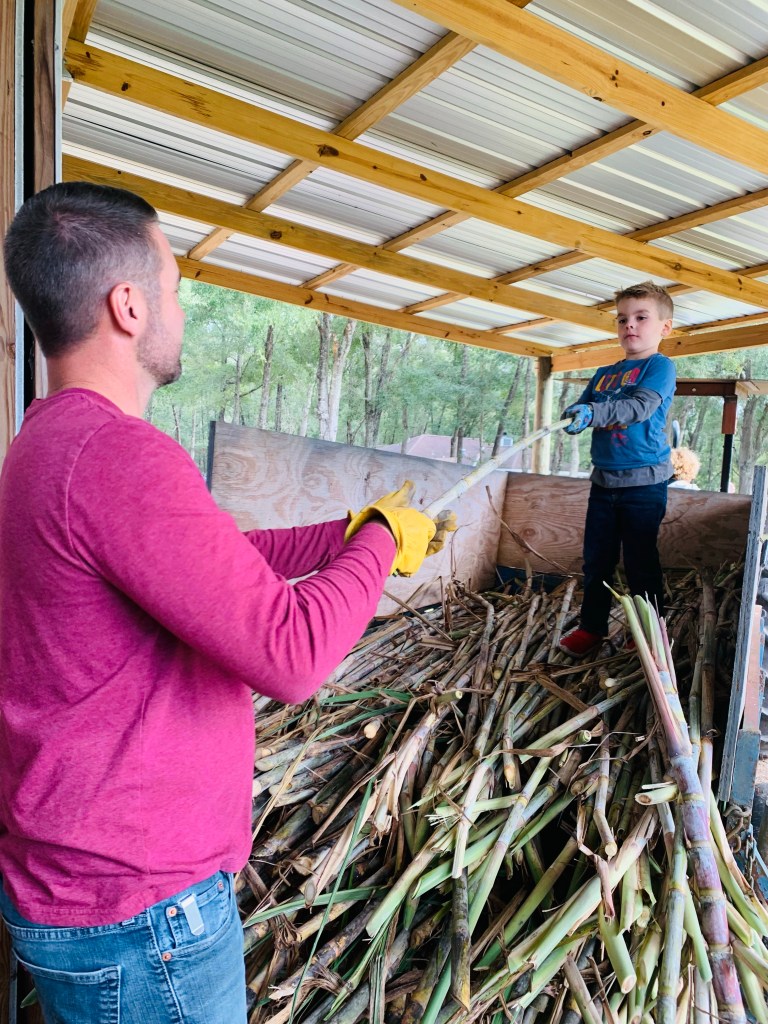
We park near the edge of land where sugar cane once stood tall just days before—recently chopped and stacked, waiting for its transformation.
I had been graciously invited by my friend Donn Smith to experience his family’s annual cane boil, and as a Southern chef and lifelong food lover, this felt less like an outing and more like pilgrimage. Disney for food historians. A living archive made of fire and steel.
The Table (Because There Is Always a Table)
Before I even reach the boil, I am stopped by what every true Southern gathering requires: an unfolding card table overflowing with generational dishes and desserts. Containers, platters, foil-wrapped mysteries, and handwritten labels—each one carrying a story whether spoken or not.
As hospitality tradition dictates, I arrive with an offering: a basket of country ham scones. I gently wedge them onto the already crowded table like an unrequested entrance fee and set out a jar of cane syrup pecan butter beside them.
“Move over, molasses,” I joke aloud, “cane syrup wants a chance.”
Not out of rivalry. Out of reverence.
Molasses has had the spotlight for decades—but the liquid gold boiling across the yard deserves its flowers too.
Meeting the Keepers of the Tradition
Donn pulls me away from the table and begins introducing me to his family—warm, welcoming, and generous in that effortless Southern way that makes you feel like you’ve been there your whole life.
Within minutes, I am told where the drinks are, where to stand, and most importantly:
“Make yourself at home.”
Truthfully, it already felt like home.
We walk toward the boil operation, and my chef brain goes quiet in awe.
From Field to Fire
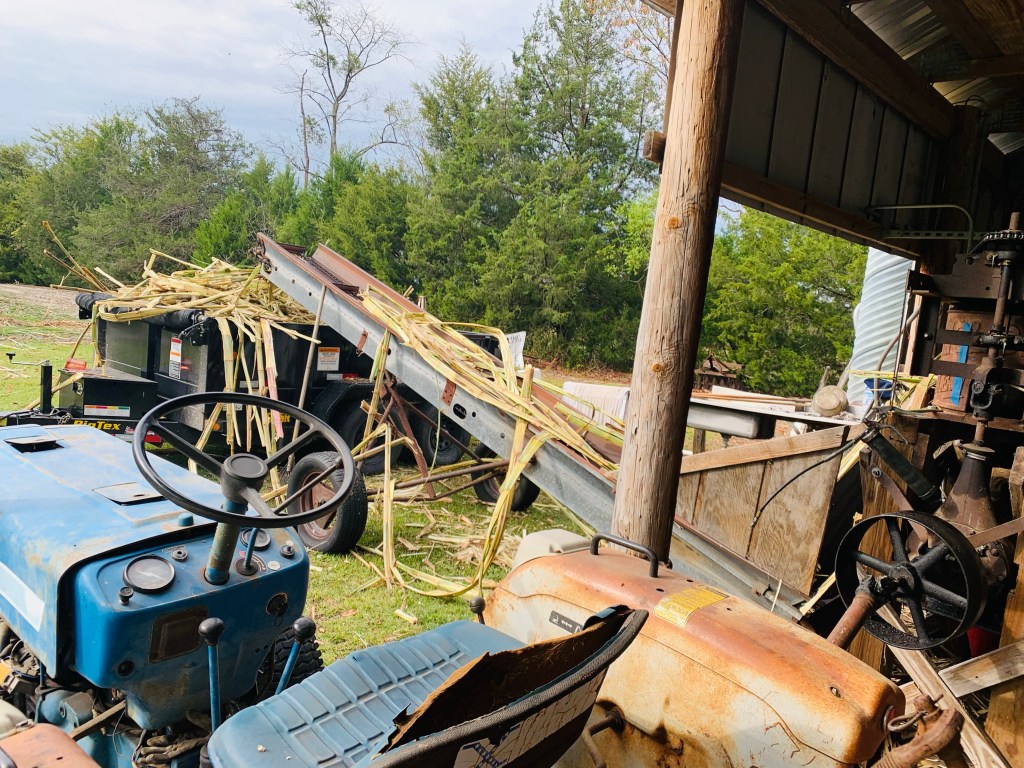
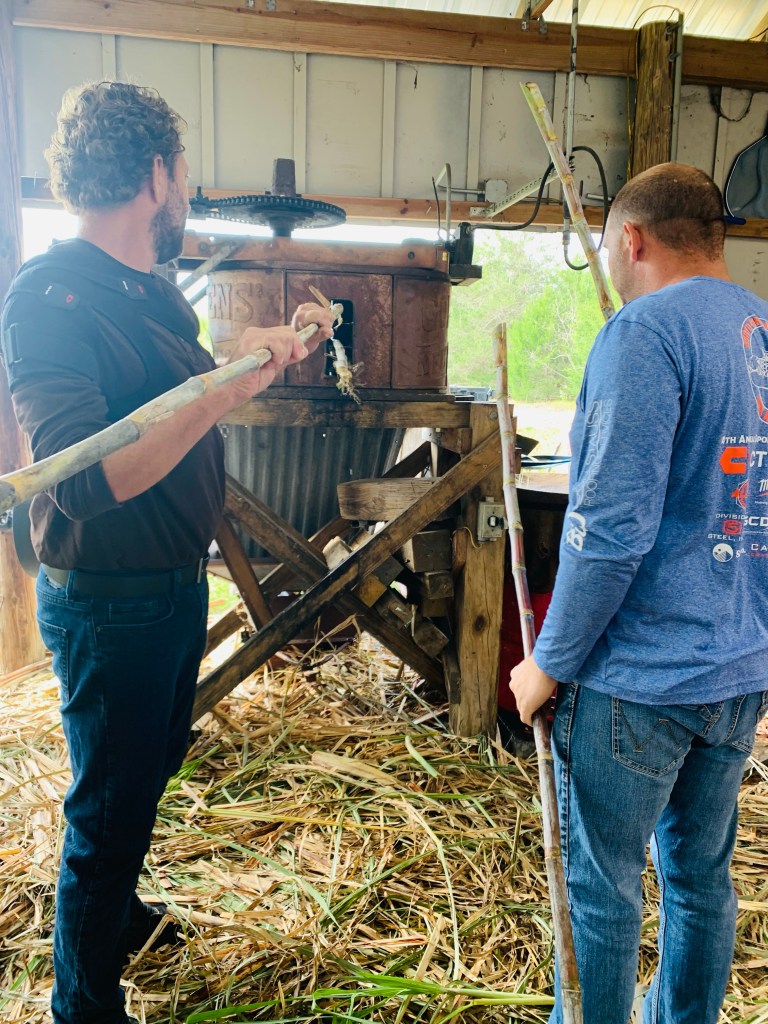
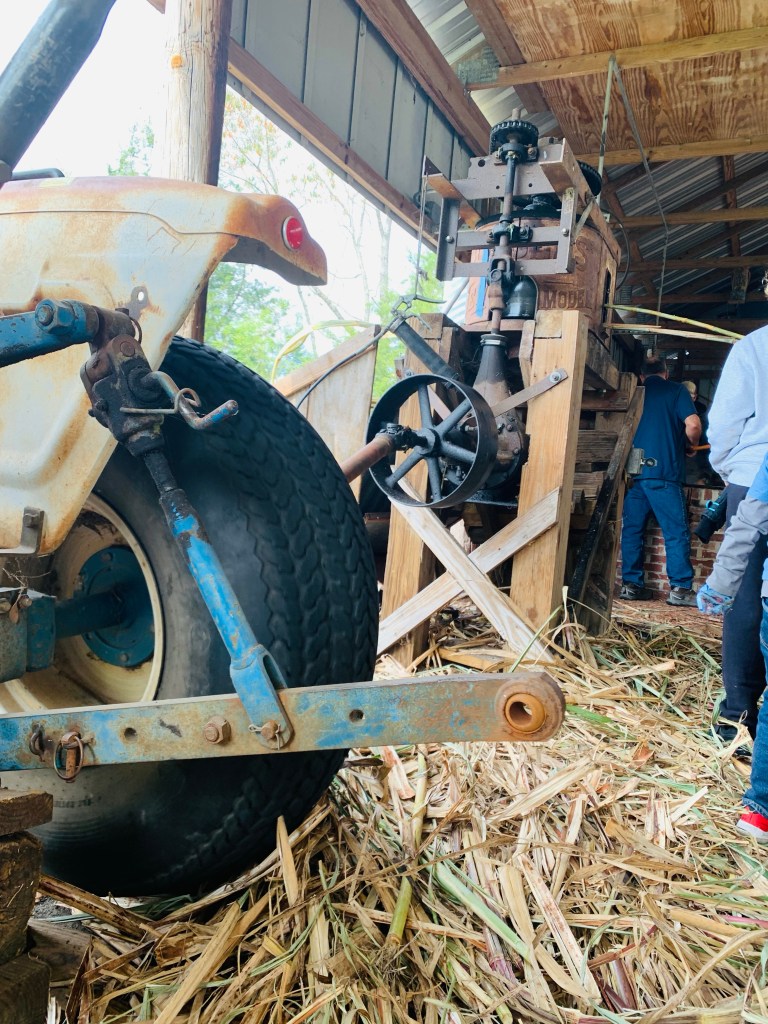
“The cane gets harvested and brought over here on that trailer,” Donn explains, pointing to a weathered machine that looks equal parts antique and ingenious. “This is the original press they’ve used forever.”
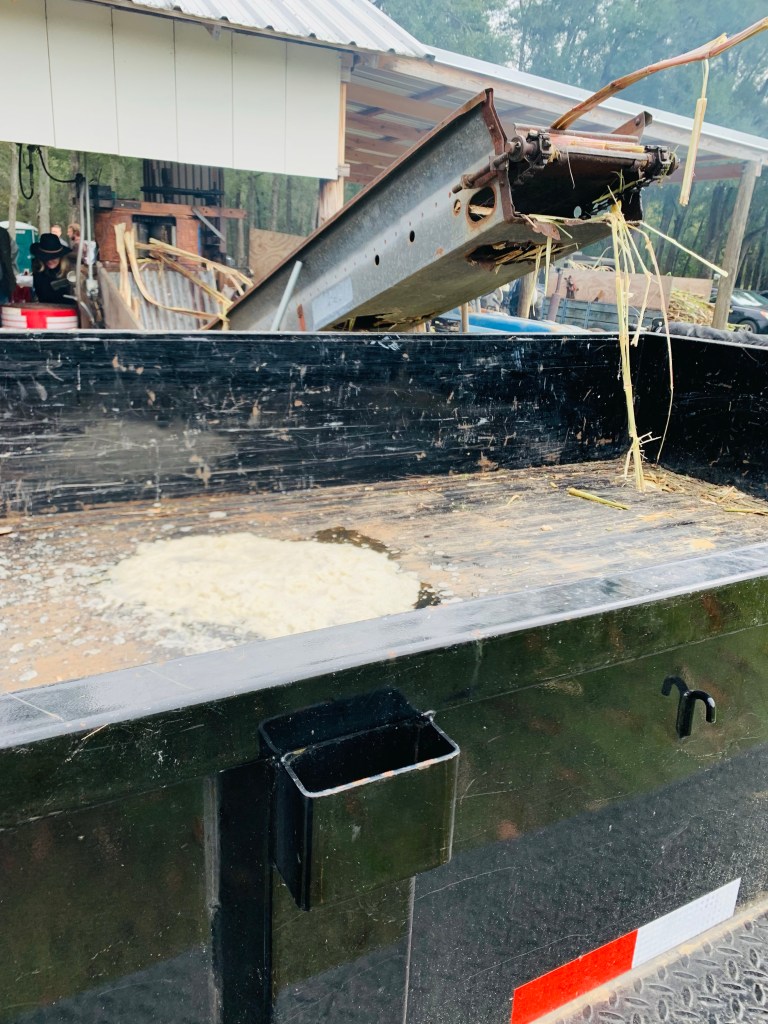
I watch as a stalk of sugar cane is fed into the machine and crushed. The fibrous remains tumble out the back while pale green juice streams forward, filtered through a pool skimmer and into a large drum.
The system is powered by a tractor—its rear tire lifted onto bricks so the rotation cranks the press. Improvised engineering at its finest.
“We didn’t always have this setup,” he adds, tracing a pipe that runs from the drum across the barn beams and ends in a spigot positioned directly above the cauldron. “But this made it easier. No more hauling five-gallon buckets all day.”
That sentence alone tells you everything about cane boils.
They are not about perfection.
They are about persistence.
Farmers, out of necessity, become brilliant engineers. They piece together what they have, adapt what they can, and create systems that work—not because they are modern, but because they are meaningful.
No two cane boils look exactly alike.
And that is part of their beauty.
The Cauldron and the Craft
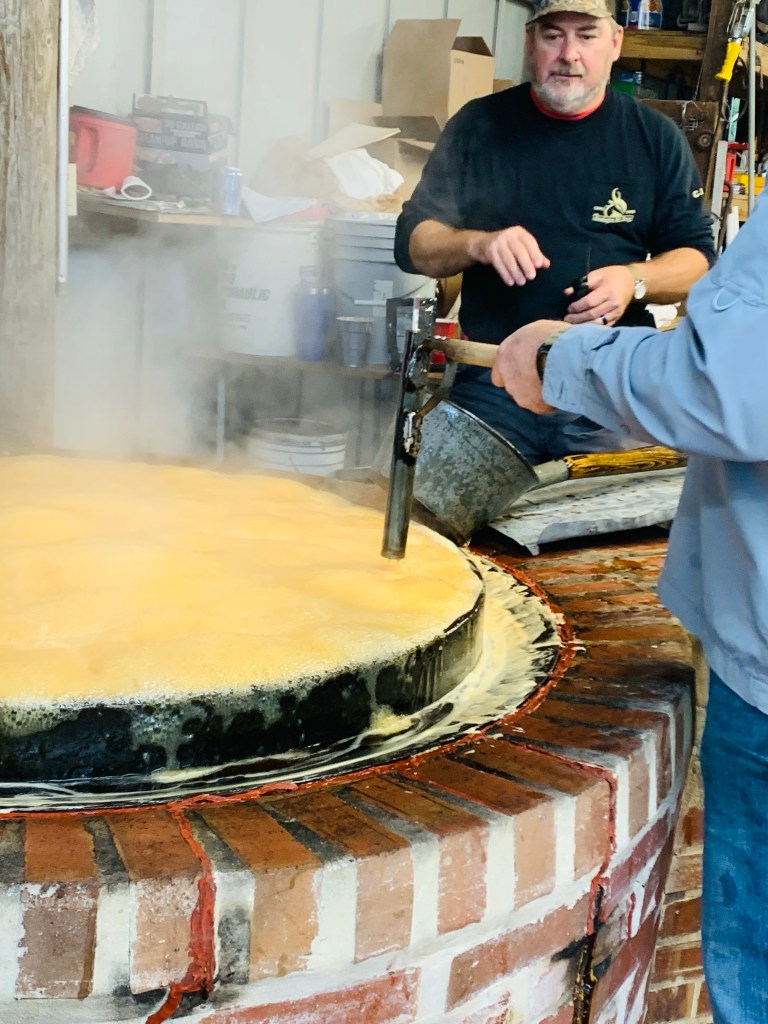
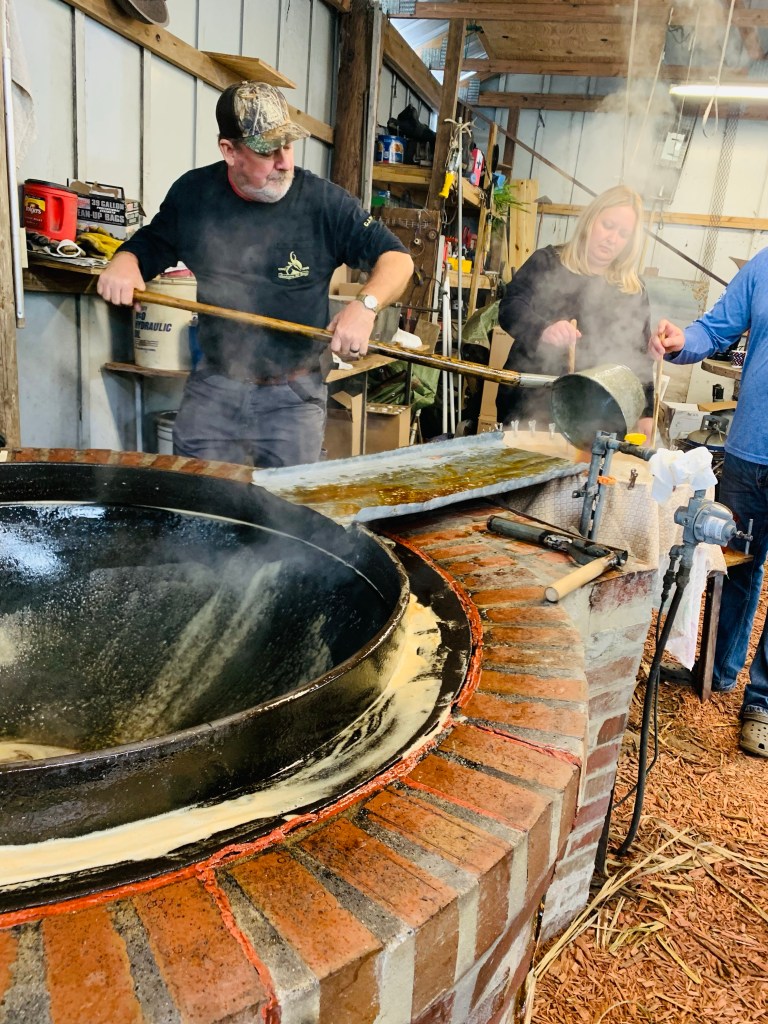
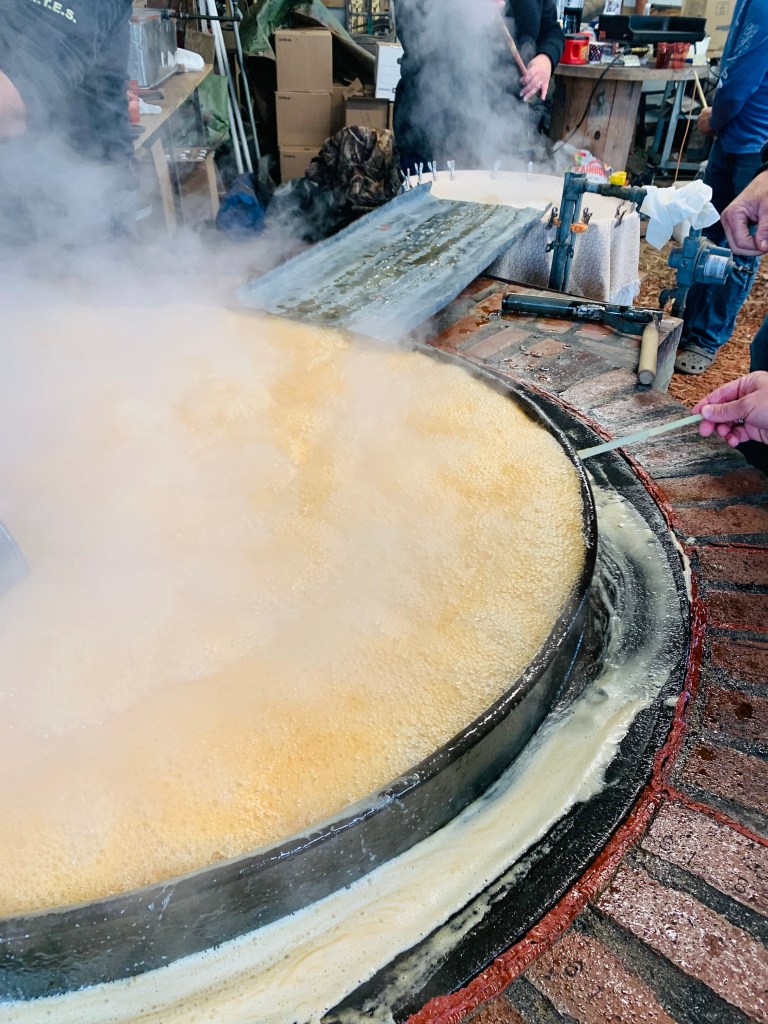
Donn’s grandfather steps forward toward the massive cauldron, and the energy shifts slightly. He is the patriarch—the keeper of timing, texture, and instinct. The kind of knowledge that cannot be Googled or rushed.
He doesn’t use a thermometer.
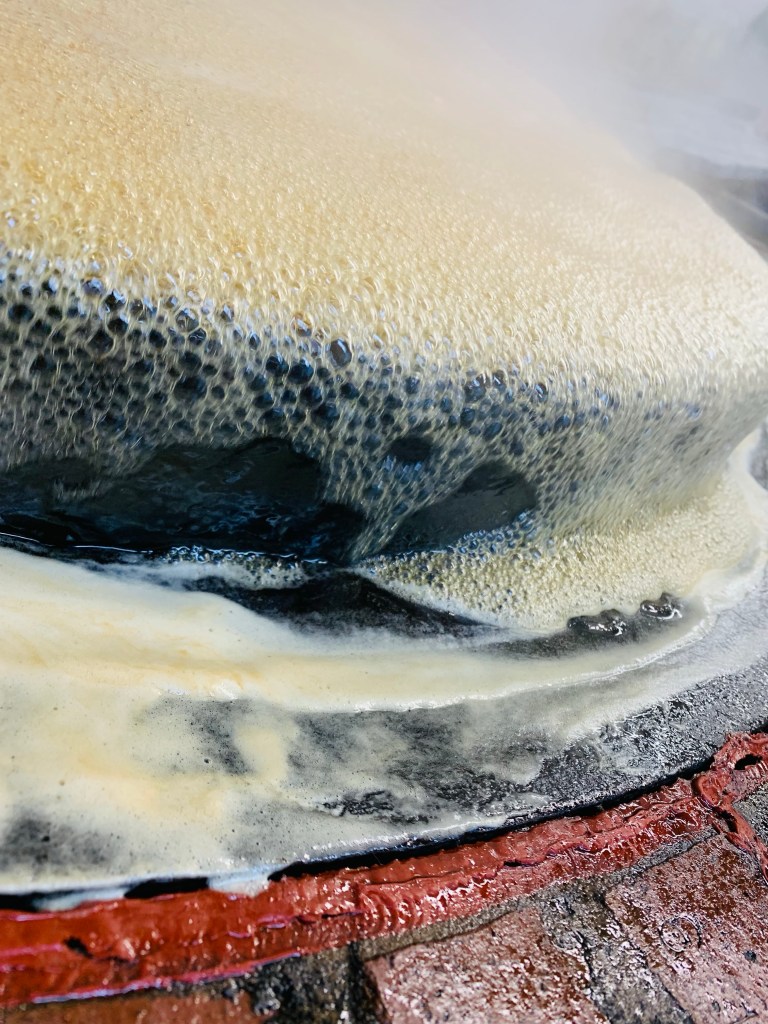
He watches the bubbles.
“That means it’s close,” he says quietly.
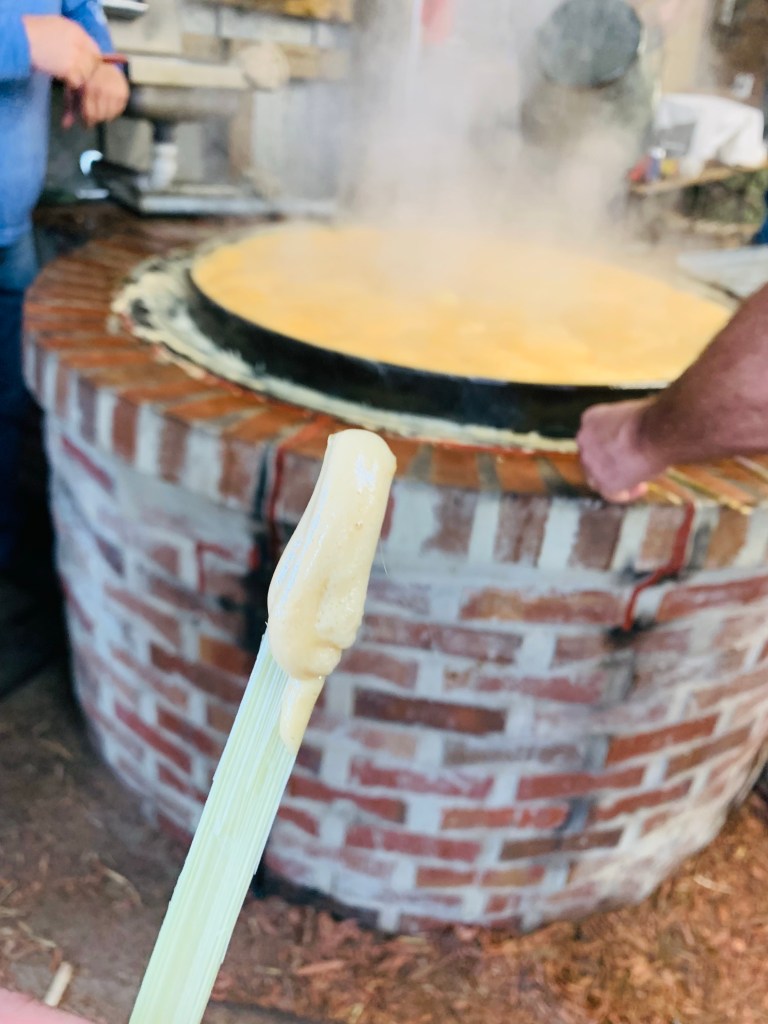
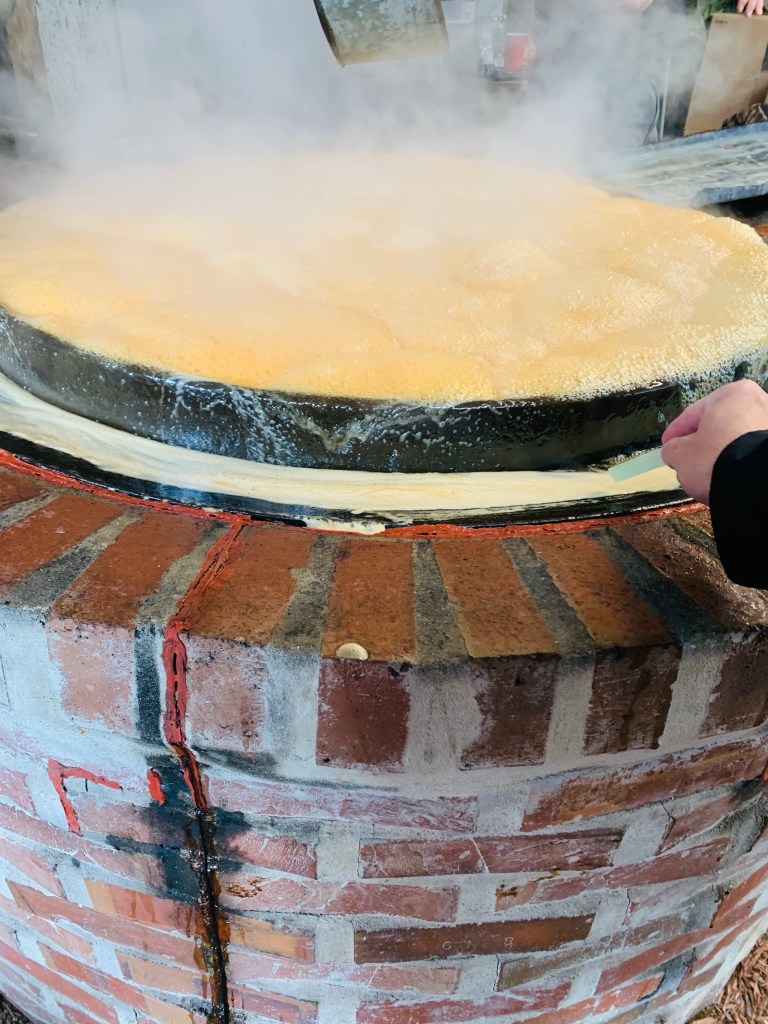
He takes a simple wooden ice cream spoon, scrapes along the rim where the syrup has overflowed and caramelized, and rolls it into a small ball. Strings of glossy cane candy stretch and shimmer before he twirls his wrist to break them free.
“Have you ever had cane candy?” he asks.
“No,” I answer honestly. “But it looks incredible.”
And it is.
As the juice boils, water slowly evaporates until what remains thickens into syrup. Throughout the process, impurities are skimmed carefully from the surface to preserve clarity and flavor. Meanwhile, small spills over the fill line cook further along the edge of the cauldron, turning into soft, caramel-like candy—dark, rich, and deeply flavored.
It is the unofficial delicacy of the boil.
And, quietly, a reward.
You only get it if you are present.
And, if we are being honest, only if the cauldron keepers like you.
More Than Syrup: A Living Tradition
A cane boil is not just a production process. It is an act of togetherness.
The fire burns all day.
Stories circulate.
Music drifts in and out.
Generations gather without needing an agenda.
The journey begins long before the boil itself—planting, tending, harvesting thick stalks by hand, crushing the cane, and slowly cooking the juice over open heat until it becomes syrup. It is labor-intensive, time-consuming, and deeply communal work.
And that is precisely why it endures.
The Complicated History We Cannot Ignore
Sugarcane carries a brutal historical legacy. That truth does not disappear simply because the setting is warm, familial, and joyful. Across the world—not just in North America—sugar production has been tied to exploitation, forced labor, and violence.
To speak about cane syrup honestly means holding both realities at once:
the sweetness of tradition
and the bitterness of history.
Today, there is a growing movement to reclaim small-scale cane production and preserve traditional methods with transparency and cultural awareness. Many modern cane boils now include storytelling, demonstrations, and historical conversations alongside the cooking process itself.
Not as performance.
But as remembrance.
Is Cane Syrup Really “Dying”?
I have heard people claim that cane syrup is a thing of the past. That it has been replaced. Forgotten. Obsolete.
They are wrong.
It may not be as commercially visible as molasses or maple syrup, especially outside the South, but it is far from extinct. Farmers markets, small farms, and family producers continue to bottle it each season. You just have to know where to look—and often, you have to show up in person.
Which, in many ways, is the point.
The Flavor of Memory
Cane syrup is not just sweet.
It is layered. Deep. Almost operatic in flavor.
Somewhere between molasses and maple, yet entirely its own. Rich, warm, and complex with notes that deepen as it cooks. When turned into candy or folded into butter, it softens and mellows, revealing tones of brown sugar, smoke, and earth that feel both nostalgic and refined.
It is not caramel.
It is something older.
Why It Still Matters
By the time the syrup is bottled and the fire burns low, what remains is more than a product. It is continuity. A quiet act of cultural preservation carried out without spectacle.
Cane boils survive because families choose to keep showing up.
Because elders pass down knowledge.
Because communities gather around fire instead of convenience.
In a world that moves faster every year, the cane boil insists on slowness.
On presence.
On remembering where sweetness actually comes from.
And perhaps that is why it still feels sacred.
Not because it is perfect.
But because it is alive.
 THE FOOD STORIES PROJECT