
The variations of this sauce that have moved through my family are expansive. They began with my grandmother Rella—a complicated woman who never approved of my mother, had a tumultuous relationship with my father and his sister, and yet loved us, her grandchildren, with unmistakable devotion.
I recall nothing but love and heartfelt gestures from her.
I still remember her house from when I was five: the open kitchen, swivel chairs, the television always on with that same soap opera, the corner cabinet with the candy dish, the piano we thought was a toy, and the quiet rhythm of a home that always smelled like tomatoes and garlic.
I don’t remember Grandma Rella ever making a meal that wasn’t Italian.
Sunday Sauce. Lasagna. Stuffed Shells. Meatballs.
All the Italian comforts that somehow also appeased picky children.
I’m sure she cooked much more, but we always requested pasta.
I still do.
She would make big bowls of meatball mix, scoop them with a spoon, roll them between her hands, and plop them into a pan, turning them as they browned and draining them on paper towels. Her sauce would already be simmering on the back of the stove before we even arrived.
Was it a secret sauce?
Or did she simply understand that sauce takes longer than a visit to be done right?
Her sauce and meatballs existed in a recipe box somewhere, but we wouldn’t find them until after my aunt passed. But no one ever made them the same again.
That’s the thing about recipes — they never include the same energy.
No amount of culinary mastery can ever fully replicate the energy of a grandmother’s love. Ever.
Watching the Tradition Continue
Now I watch my mother do the same thing. Her own version, her own way.
And it is one of the most beautiful displays of love I know.
You can already see it imprinting on my nieces and nephews — little invisible grandma heart tattoos across their lips as red sauce slides off slurped pasta noodles all over their face.
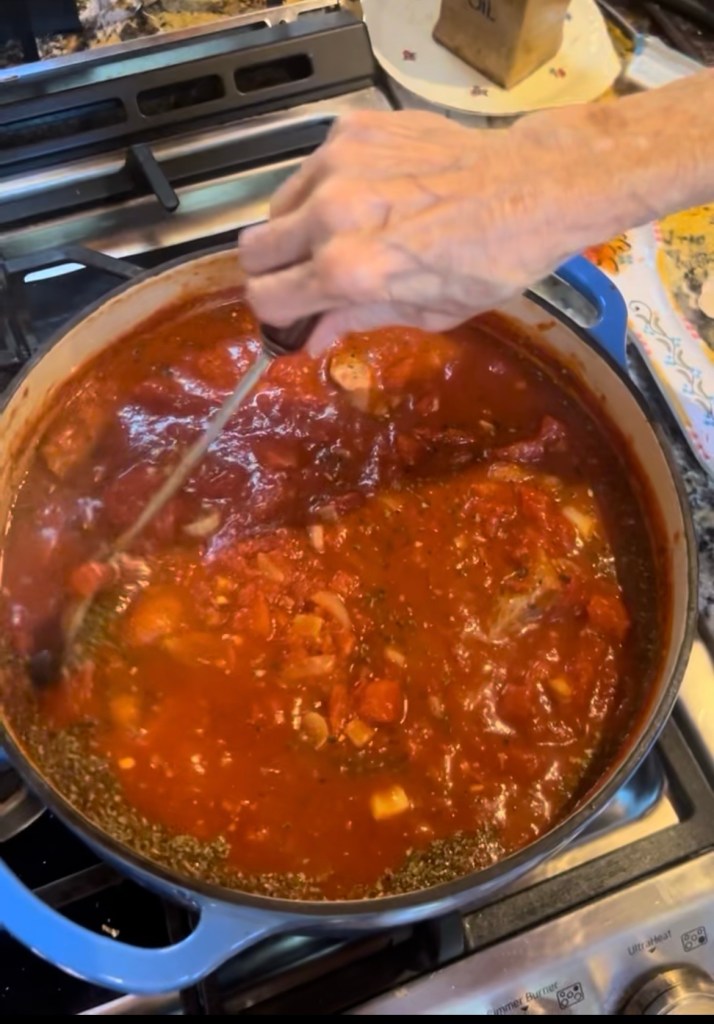
Her mastery of sauce is built from decades of necessity, luxury, lived experience, a daughter who became a chef, and most importantly, her hands. In her eighties, I believe she makes the best version of this sauce she ever has. I recently made it with her in the kitchen and I’m glad I recorded it. It is simpler now, but more intentional. More cared for. More patient.
When we were younger, Mom made the sauce in the crockpot.
She was a busy mother, constantly spread thin, and the crockpot gave her something invaluable: time.
My job was mise en place long before I knew the term existed.
I would haul out that heavy brown-and-tan crockpot — two settings, low and high, with a flimsy cord that always unraveled and dragged behind me, catching cabinet doors and corners before landing with a wobble on the counter.
I would gather everything:
large containers of Italian herbs, oregano, basil, a whole bulb of garlic, cans of tomatoes, fresh vegetables, and a bottle of wine already open from the night before.
The cans of whole plum tomatoes would get opened and plopped into the crockpot. Then I would grab a yellow dishwashing glove from the sink, slide it onto my hand, and go “fishing” for tomatoes — squishing them between my fingers to break them down into the beginnings of sauce.
After that, the glove came off, and my cupped hand became the measuring tool.
Two of Mom’s handfuls equaled one of mine.
I knew this by observation alone.
Garlic, onions, and celery went in.
A splash of red wine.
High for an hour. Then low for the day.
We would leave for school and work while the sauce slowly transformed.
The Smell of Home
When we came home, the scent would greet us at the back door.
Tomato. Garlic. Warmth. Safety.
If Mom picked us up from school, she usually stopped by Publix and grabbed a baguette for garlic bread. Without fail, I would break off a corner, hollow out the soft center, and dunk it straight into the sauce to “taste test.”
Every time, I got yelled at for leaving the bread carcass in the bag.
Every time, I denied it.
Every time, everyone knew it was me.
There was always meat defrosting in the sink — chicken, sausage, meatballs, country pork ribs, whatever was available. Everything would get seared and added to the sauce to finish cooking until dinner.
Setting the Table (The Ritual)
Whichever child was being the most obnoxious was usually assigned to set the table.
That meant:
- The red and white checkered plastic tablecloth
- Two old Chianti bottles layered in candle wax
- Shallow pasta bowls
- A fork and a spoon
Then came the procession:
bowls of noodles dressed in olive oil so they wouldn’t stick,
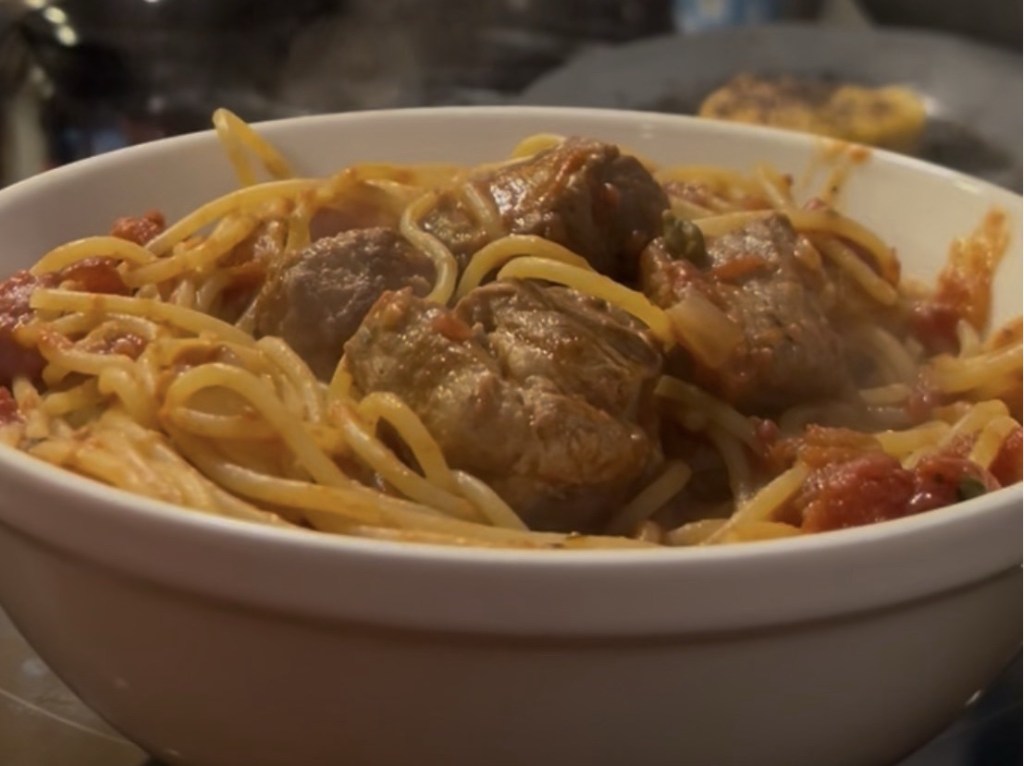
the sauce with a variety of meats,
garlic bread wrapped in a kitchen towel,
Romano cheese,
and a green salad dressed in red wine vinaigrette.
Final touches:
Lighting the candle.
Running to the living room.
Turning on the soundtrack to our Italian dinners — Johnny Mathis, Nat King Cole, Pavarotti, or Italian love songs.
This meal never solved disagreements.
It never magically fixed our misunderstandings.
But it always got us to the table.
And it always connected us.
The Invisible Lesson of a Family Meal
I didn’t realize how much my childhood shaped my understanding of hospitality and cooking.
If you were loved by us, you ate this meal with us.
Dinner lingered.
Kids eventually wandered off to watch TV.
But a few always stayed behind.
Sometimes there was dessert.
Sometimes it was finishing the bottle of wine while stories unfolded, and life updates were shared.
And sometimes it was just Mom, still eating — because she has always been the slowest eater in the family. I now realize it was the only time she rarely got bothered to do tasks. She had her whole family with her in one place. She was trying with all her might to hold on to that no matter how cold her food got. It was an easy sacrifice.
Dad, unwilling to miss out on the fun, would inevitably fall asleep at the head of the table — providing bonus entertainment as we slipped tiny bites of food into his mouth whenever his snoring interrupted conversation.
The Reality of the Recipe
This recipe is just the bones of the dish.
The truth is: it was never the same twice.
Each time Mom would take her first bite and ask,
“How is it?”
And the table would respond:
“This is a good batch.”
“It needs more garlic.”
“Could cook a little longer.”
“I like the fresh basil.”
All while slurping pasta drenched in sauce and piling on Romano cheese, with garlic bread in the other hand wiping the bottom of the plate clean.
Now, when cooking for the grandkids, Mom makes a base sauce and pulls some aside before adding meats — keeping it simple for their taste buds. And if she does make meatballs she makes them cute little bite sizes. There is always a quart-size freezer bag of sauce ready for the littles.
Always.
The Meal as Memory, and Maybe Medicine
I recently tried to recreate this dinner for the kids, hoping they could experience a piece of our childhood. Grandma wanted the whole family over, but its too much for her to alone, so helped.
It is harder now.
Families are more complicated.
Relationships are heavier.
History sits between people like an unspoken guest at the table.
Those of us trying are tired.
Those unwilling to soften are slowly alienating themselves.
And still, I wonder:
Could something as simple as a shared family meal bring us closer again?
My mother worked incredibly hard to keep us together.
I’m not sure we fully understood the effort it took to maintain that sense of family.
I worry we may not put the same effort into keeping the next generation close.
So far, we haven’t.
Its hard sometimes finding the balance between the traditions of my parents and us and creating our own traditions with our own families.
But I still believe Mama Rella’s sauce is magical.
And I want to believe that if we keep the tradition alive, it might not fix everything —
but it could soften something.
It could nourish something.
It could heal, quietly, in the way only food and memory can.
So for now, Sunday sauce may only be once in while, and that’s better than it being gone forever in a distant memory.
The Traditional Meal: Recipes
Mama Rella’s Sunday Sauce (Final Form)
This is a feeling recipe. Adjust with care, intuition, and love.
Ingredients
- 2–3 cans whole plum or crushed tomatoes
- 4–6 cloves garlic, minced
- 2–3 tbsp extra virgin olive oil
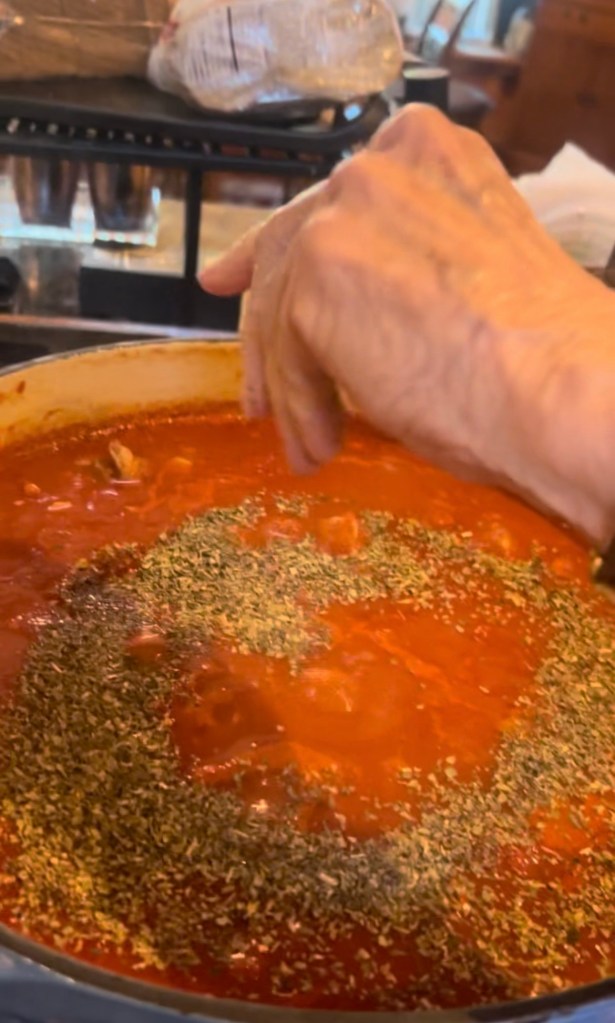
- 1–2 tsp dried Italian herbs (oregano, basil, or blend)
- ¼–½ cup red wine
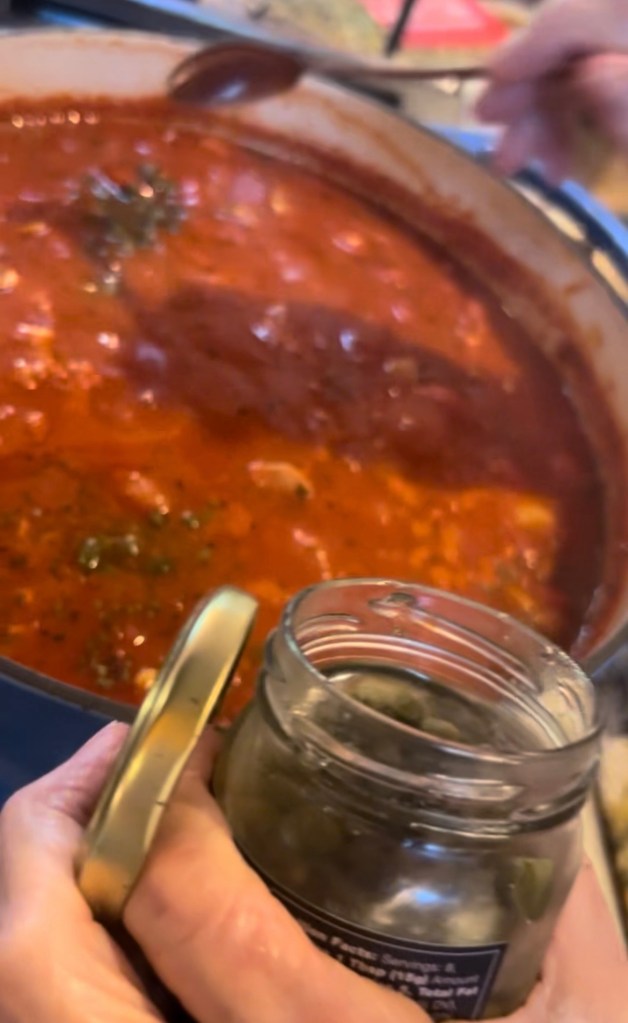
- 2-3 tbsp capers
- Salt and black pepper, to taste
Tools
- Large pot or crockpot
- Wooden spoon
- Knife & cutting board
Step-by-Step (SBS)
- Heat olive oil in a large pot over medium heat.
- Add garlic and gently sauté until fragrant (not browned).
- Add canned tomatoes. If using whole, crush by hand or with a spoon.
- Stir in herbs, salt, and pepper.
- Add a splash of red wine and stir.
- Bring to a gentle simmer, then reduce to low.
- Let simmer for at least 2–4 hours (longer if possible), stirring occasionally.
Make It Work for You
- Add seared meat (sausage, meatballs, pork, or chicken) for a fuller sauce.
- Simmer all day in a crockpot for a busy schedule.
- Freeze in quart bags for future meals (just like Mom does).
Family Green Salad with Red Wine Vinaigrette
Ingredients
- 1 head romaine lettuce, chopped
- 1–2 tomatoes, chopped
- 1 cucumber, sliced
- 1 celery stalk, thinly sliced
- 1 clove garlic, finely minced
- ¼ cup Romano cheese, grated
- 3 tbsp extra virgin olive oil
- 2 tbsp red wine vinegar
- Salt and black pepper, to taste
Tools
- Large salad bowl
- Whisk or fork
Step-by-Step (SBS)
- Combine romaine, tomatoes, cucumber, and celery in a large bowl.
- In a small bowl, whisk olive oil, red wine vinegar, garlic, salt, and pepper.
- Pour dressing over salad and toss gently.
- Finish with grated Romano cheese just before serving.
Make It Work for You
- Add olives or fresh basil for a deeper Italian feel.
- Chill the bowl beforehand for a classic dinner-table salad experience.
Classic Garlic Bread (The Publix Baguette Tradition)
Ingredients
- 1 baguette
- ½ cup butter, softened
- 3–4 cloves garlic, finely chopped
- Pinch of salt
Tools
- Baking sheet
- Knife
- Small bowl
Step-by-Step (SBS)
- Preheat oven to 375°F.
- Slice baguette lengthwise.
- Mix butter, garlic, and salt in a bowl.
- Spread generously over the bread.
- Bake for 10–12 minutes until golden and fragrant.
- Slice and serve wrapped in a kitchen towel for the full family effect.
Make It Work for You
- Broil for 1–2 minutes at the end for crispy edges.
- Add Romano or parsley for an upgraded version.
“If the bread isn’t slightly over-toasted and someone isn’t sneaking a piece before dinner, you’re not doing it the family way.”

 THE FOOD STORIES PROJECT